NDIS progress notes are written records of the support delivered to a participant during each shift or session. They document what happened, how the participant responded, and how the support links to their plan goals. For registered providers, progress notes are core audit evidence: they must be objective, factual, dated, signed, and kept for at least seven years under the NDIS Practice Standards.
A support worker finishes a shift and writes: "Had a good day. Client was happy. All good."
That single line, multiplied across a team and a year, is how providers fail the documentation part of an audit. Not because the care was bad. The care was probably fine. But "had a good day" proves nothing. It's not objective, it's not linked to a goal, and an auditor reading it six months later learns nothing about what support was actually delivered or why it was funded.
Progress notes are the most frequent piece of writing your organisation produces, and the most frequently done badly. This guide covers what NDIS progress notes must contain, the difference between objective and subjective language, what auditors check, and how to keep notes compliant across a whole team without drowning in admin.
What are NDIS progress notes?
NDIS progress notes are the running written record of the supports a participant receives.
Every time a support worker delivers a service, they record what was provided, how the participant engaged, any issues that came up, and how it connects to the participant's goals. The official NDIS guide to report writing also explains how providers should document supports delivered, outcomes achieved, progress towards participant goals, challenges, risks and recommended next steps.Some providers call them shift notes, case notes, or session notes. The NDIS context is the same: they're the day-to-day evidence that funded supports were actually delivered.
Short answer: NDIS progress notes are dated written records documenting the support delivered each shift, the participant's response, and the link to their plan goals. They're the primary evidence that funded supports happened.
They do three jobs at once:
Continuity of care. The next worker knows what happened and what to watch for.
Participant outcomes. They track progress toward the participant's goals over time.
Compliance evidence. They prove to an auditor, and to the NDIA, that the support was delivered as claimed.
That third job is where providers underestimate them. A progress note isn't just an internal handover. It's a financial and compliance record.
What must be included in an NDIS progress note?
Here's what a compliant note captures. Not every note needs a novel, but each should cover the essentials.
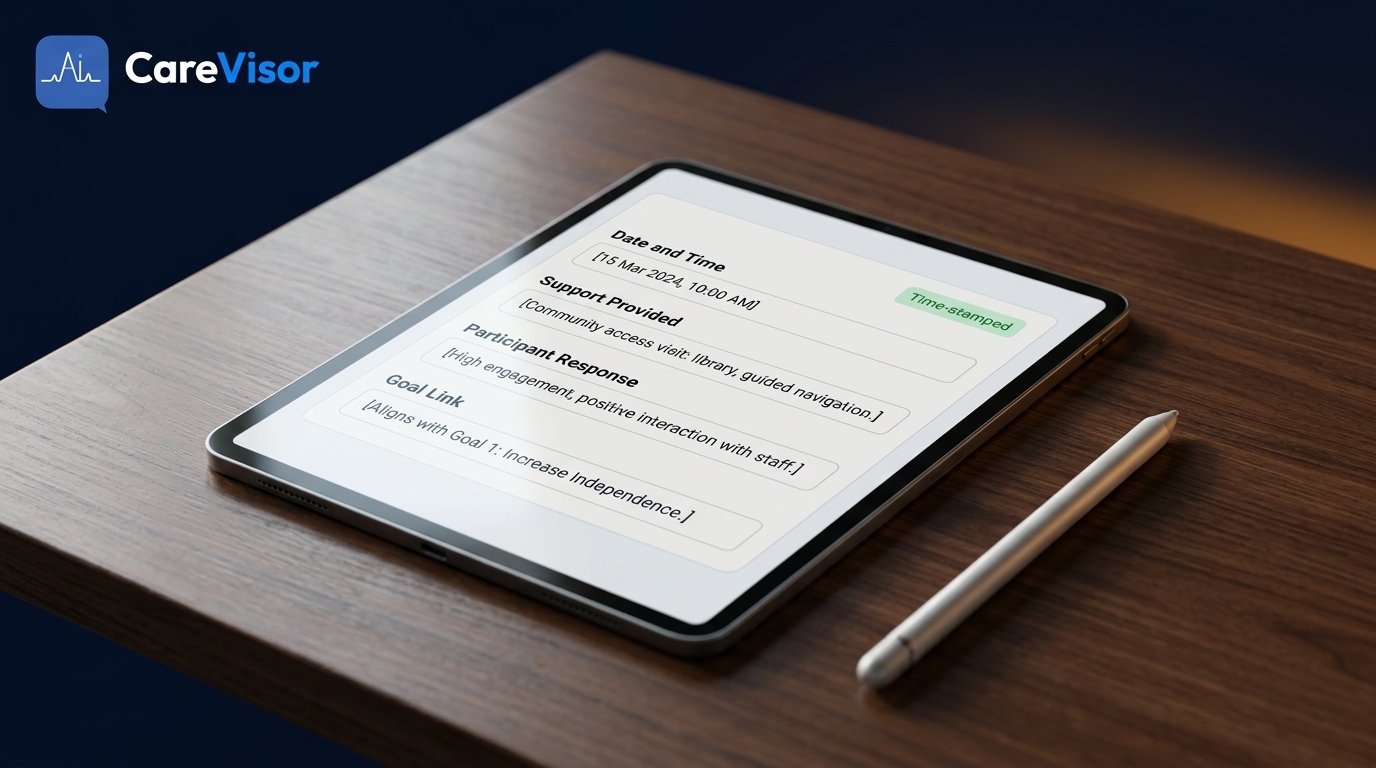
Element | What it records |
|---|---|
Date and time | When the support was delivered, and its duration |
Participant name | Who the support was for |
Worker name and signature | Who delivered it, with an identifiable sign-off |
Support provided | What was actually done during the shift |
Participant response | How the participant engaged or responded, factually |
Goal link | How the support connects to a plan goal |
Issues or incidents | Anything notable, including anything that may be reportable |
Follow-up | Actions needed, or handover for the next worker |
Key point: The two elements most often missing are the goal link and objective participant response. A note that records what was done but not how it ties to a funded goal leaves the provider unable to justify the claim at audit.
If something during the shift was a reportable incident, the progress note is not a substitute for a formal incident report. It should reference that an incident occurred, and the incident goes through your SIRS process. Our SIRS compliance guide covers where that line sits.

Objective vs subjective: the language that passes audit
This is the single biggest quality issue in NDIS progress notes, so it's worth slowing down.
Auditors, and good clinical practice, want objective language: what you observed, factually, without opinion or assumption. Subjective language records your interpretation, which isn't evidence.
Here's the difference in practice:
Subjective (weak) | Objective (strong) |
|---|---|
"Client was happy." | "Participant smiled and initiated conversation during the activity." |
"He was aggressive." | "Participant raised his voice and pushed the table away when asked to stop." |
"She had a good day." | "Participant completed her morning routine independently and attended her 10am appointment." |
"Seemed tired." | "Participant yawned frequently and declined the afternoon walk, saying he wanted to rest." |
The pattern: objective notes describe observable behaviour. Subjective notes label it. "Happy," "aggressive," "good," and "tired" are conclusions. What did you actually see or hear? Write that.
Write NDIS progress notes in objective language: record what you observed and what the participant said or did, not your interpretation of it. "Participant declined lunch" is evidence. "Participant was in a bad mood" is opinion.
This matters beyond audits. Objective notes protect the participant (accurate record), the worker (defensible account), and the provider (compliant evidence). Everyone wins when the note sticks to facts.
How to write NDIS progress notes: a simple structure
Workers write better notes when they have a structure to follow. A widely used one is the simple four-part format.
What was planned. The support scheduled for the shift.
What happened. What was actually delivered, factually.
How the participant responded. Objective observation of engagement or outcome.
What's next. Follow-up, handover, or actions for the next shift.
A worked example:
"Attended participant's home 9am to 11am for community access support (goal: build confidence using public transport). Travelled together by bus to the local shopping centre. Participant purchased items independently and used the ticketing machine with one verbal prompt. Appeared more confident than the previous session, initiating the bus tap-off without prompting. Next session: attempt the return trip with reduced prompting."
That note is dated, timed, goal-linked, objective, and hands over to the next shift. It took two minutes and it would stand up at audit.
For providers training a team, a shared template plus these four prompts is the fastest way to lift note quality across the board. Consistency is what auditors reward.

What records must NDIS providers keep?
Progress notes sit inside a broader record-keeping obligation, so here's the direct answer to the question providers search most.
NDIS providers must keep records that demonstrate they deliver supports safely and to the Practice Standards. Alongside progress notes, that includes:
Participant files, service agreements, and consents
Incident records and complaints
Worker screening and staff credentials
Rosters, timesheets, and payroll records
Progress notes and support delivery records
Short answer: NDIS providers must keep progress notes, participant files, service agreements, incident and complaints records, staff credentials, and financial records. Most must be retained for at least seven years, longer for records involving children.
Progress notes specifically must be retained for at least seven years, stored securely under the Australian Privacy Principles, and be retrievable on request. For the full file picture, see our NDIS participant file checklist, and for how records get sampled, what NDIS auditors check.
For the official minimum documentation fields, review the NDIS record-keeping requirements, which explain what providers must record to support accurate service delivery and payment claims.
Key takeaways
NDIS progress notes are dated records of support delivered, the participant's response, and the link to plan goals.
Eight elements make a note compliant; the goal link and objective response are the two most often missing.
Objective language (what you observed) is evidence. Subjective language (your interpretation) isn't.
A simple four-part structure lifts note quality across a whole team.
Progress notes must be kept for at least seven years and produced on request at audit.
What auditors check, and the mistakes that fail providers
When an auditor samples your progress notes, they test for the same things every time:
Consistency. Are notes written for every shift, or are there gaps?
Timeliness. Were notes written at or near the time of support, not reconstructed weeks later?
Objectivity. Do notes record facts or opinions?
Goal linkage. Do notes connect support to funded goals?
Legibility and identification. Can you tell who wrote each note and when?
The common failures:
Missing notes. Shifts with no note at all. The support was claimed but there's no evidence it happened.
Copy-paste notes. Identical wording across days, which reads as notes written in bulk rather than per shift.
Subjective-only notes. "Good day" entries that record nothing observable.
No goal link. Notes that describe activity with no connection to why it's funded.
Late or backdated notes. Entries clearly written long after the fact, with no audit trail to show when.
That last one is where paper and generic tools fall down. A handwritten note or an editable document can't prove when it was actually written. A note that can be backdated isn't trustworthy evidence, and auditors know it.
Progress notes software vs paper: keeping notes audit-ready
One worker writing careful notes is manageable. A team of twenty, across multiple participants and shifts, every day, is where quality and consistency slip.
Paper or generic docs | NDIS progress notes software | |
|---|---|---|
Written at time of support | Hard to prove | Time-stamped automatically |
Backdating possible | Yes | No, audit trail on every entry |
Consistent structure | Depends on the worker | Guided by template |
Goal linkage | Manual, often skipped | Prompted or linked to the plan |
Retrieval at audit | Slow, paper chase | Instant, searchable |
Legibility | Variable | Always legible |
Short answer: NDIS progress notes software time-stamps every note, enforces a consistent structure, links notes to participant goals, and makes them instantly retrievable at audit, which paper and generic documents can't reliably do.
This is why progress notes belong inside your operating system, not in a notebook or a shared drive. CareVisor captures each note against the participant and the shift, time-stamped, structured, and linked to plan goals, with a full audit trail. When an auditor asks to see the notes for a participant over the last quarter, they're one search away, complete and dated. It's the same principle running through the whole NDIS service provider platform: capture evidence as the work happens. For the wider software view, see the best NDIS compliance software in Australia or the full feature list.
Frequently asked questions
What should be written in NDIS progress notes?
An NDIS progress note should record the date and time, the participant, the worker, the support delivered, the participant's response in objective language, how the support links to their goals, any issues or incidents, and any follow-up. Keep it factual and specific.
What is an example of a good NDIS progress note?
A good note reads: "Attended participant's home 9 to 11am for community access support (goal: confidence using public transport). Travelled by bus to the shopping centre. Participant purchased items independently and used the ticket machine with one prompt. Next session: attempt the return trip with reduced prompting." It's dated, objective, and goal-linked.
What should you not put in a progress note?
Avoid opinions, assumptions, labels, and judgemental language. Don't write "he was difficult" or "she was in a mood." Don't include irrelevant personal commentary. Record observable facts and what the participant said or did, not your interpretation.
How often should NDIS progress notes be written?
Progress notes should be written for every shift or support session, at or near the time of support. Writing them promptly keeps them accurate and avoids the audit risk of reconstructed or backdated entries.
Can I use AI to write NDIS progress notes?
AI can help structure or tidy notes, but the note must reflect what actually happened during the shift and must not fabricate detail. The worker remains responsible for accuracy. Any tool used must keep records secure under the Australian Privacy Principles.
How long must NDIS progress notes be kept?
Progress notes must be retained for at least seven years under the NDIS Practice Standards, stored securely, and be retrievable on request. Records involving children may need to be kept longer.
What is the difference between progress notes and case notes?
The terms are often used interchangeably in NDIS settings. Both record support delivered and participant response. "Progress notes" tends to emphasise progress toward goals; "case notes" is a broader term. The compliance requirements are the same.
NDIS progress notes are the most-written, most-audited, and most-underestimated records your organisation produces. The providers who pass the documentation part of an audit comfortably aren't writing longer notes. They're writing objective, goal-linked, time-stamped ones, consistently, across the whole team, because their system makes doing it right easier than doing it wrong.
Fix your notes and you fix one of the most common sources of audit findings. Leave them as "had a good day," and you're claiming support you can't prove you delivered.
See your documentation in 7 days. Start a free CareVisor trial, load your team, and see how time-stamped, goal-linked progress notes look on one dashboard from day one. Ahmed personally walks every trial provider through their audit-readiness score on day 6.
About CareVisor
CareVisor is the audit-ready operating system for Australian NDIS providers, built in Sydney by NDIS operators who have prepared for and passed Quality and Safeguards Commission audits firsthand. Progress notes, participant management, service agreements, incident reporting, worker screening, claiming, and SCHADS payroll live in one platform, mapped to the NDIS Practice Standards, with a time-stamped audit trail captured by default. Learn more about us or start your free trial at carevisor.com.au.