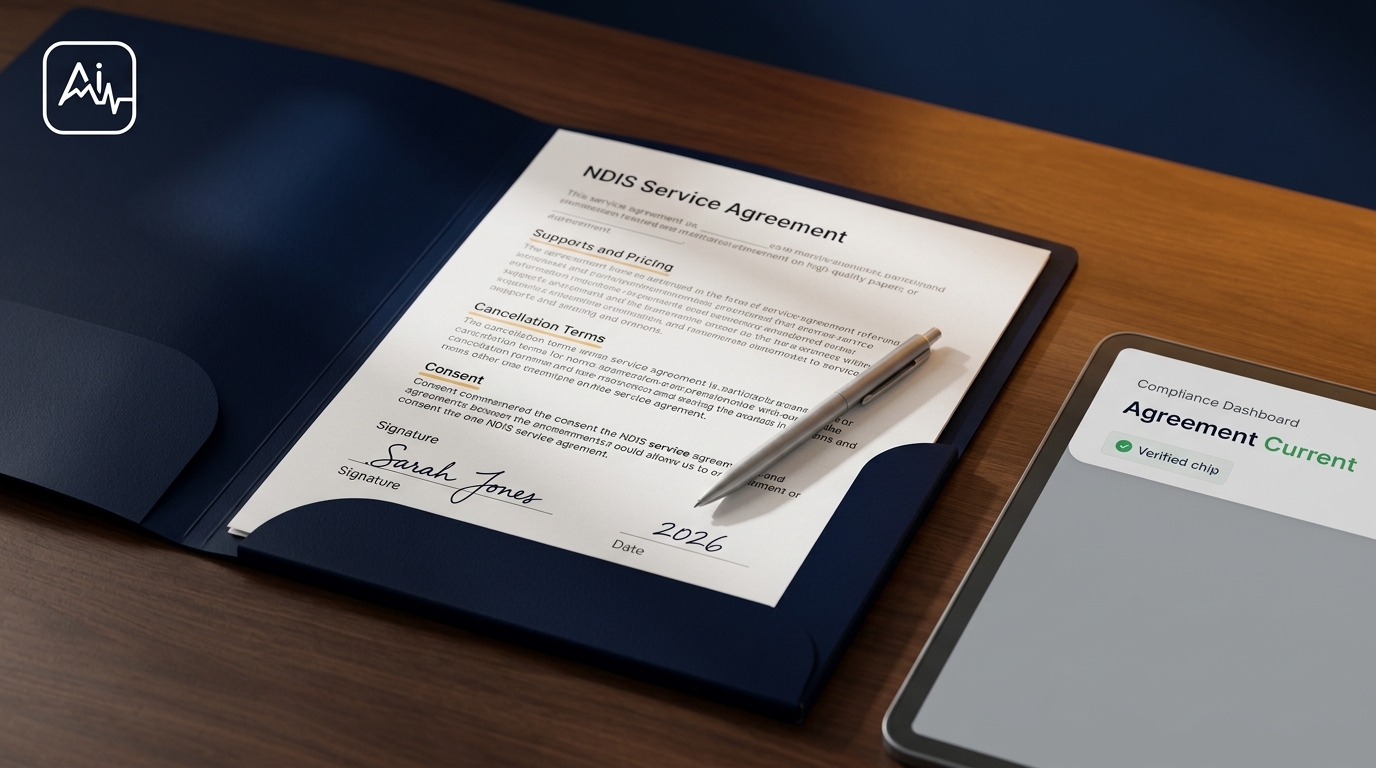
An NDIS service agreement is a written agreement between a provider and a participant that sets out the supports to be delivered, the cost, and the terms of the arrangement. While the NDIS Act doesn't mandate a service agreement for every participant, the NDIS Practice Standards effectively require registered providers to have clear, agreed, documented arrangements. A compliant agreement covers supports, pricing, responsibilities, cancellation terms, and how to end or change the arrangement.
An auditor opens a participant file. First thing they look for isn't the care plan. It's the service agreement. Is it there, is it signed, is it current, and does it actually say what it's supposed to say?
For a surprising number of providers, the honest answer to at least one of those is no. A long-standing participant with no agreement on file. An agreement signed three years ago that no longer matches the support being delivered. A template pulled off the internet that's missing half the terms the Practice Standards expect.
Each of those is a finding waiting to happen. This guide covers exactly what NDIS service agreement requirements are, what has to be in one, what auditors check, and how to keep every agreement current without it becoming a filing nightmare. If you're a registered provider, your service agreements are quiet compliance infrastructure, and they're easy to get wrong.
Are NDIS service agreements legally required?
Let's clear up the most common confusion first.
The NDIS Act does not, in every case, legally mandate a written service agreement. But that's not the whole picture, and reading it that way gets providers into trouble.
Short answer: A written NDIS service agreement isn't strictly required by law for every participant, but the NDIS Practice Standards expect registered providers to have clear, documented, agreed arrangements. In practice, that means you need one.
Here's why "not strictly required" is a trap. The Practice Standards require that each participant accesses supports that meet their needs and that the terms are clear and agreed. A verbal understanding doesn't demonstrate that at an audit. The service agreement is how you prove the arrangement was explained, understood, and agreed. No document, no proof.
For Specialist Disability Accommodation (SDA) and Supported Independent Living (SIL), the bar is higher again. SDA in particular has specific requirements around residency and service agreements, and those arrangements are the ones auditors scrutinise most.
What must be included in an NDIS service agreement?
This is the heart of the requirement. A compliant NDIS service agreement should clearly set out each of these.
Element | What it covers |
|---|---|
Participant and provider details | Full names, contact details, and the participant's NDIS number |
Supports to be delivered | The specific supports, how often, and how they'll be provided |
Pricing | The cost of each support, aligned with the current NDIS Pricing Arrangements |
Duration | Start date and, where relevant, an end or review date |
Responsibilities | What the provider will do and what's expected of the participant |
Cancellation terms | Notice periods and any short-notice cancellation charges |
Changing the agreement | How either party can request a change |
Ending the agreement | Notice period and process for termination by either side |
Feedback and complaints | How the participant can give feedback or make a complaint |
Consent | The participant's agreement to the terms, and how consent was given |
Goals link | How the supports connect to the participant's NDIS plan goals |
Key point: The two areas that most often fail an audit are pricing (agreements that don't match the current Pricing Arrangements after the annual update) and cancellation terms (missing, or not compliant with the current short-notice cancellation rules).
Note the pricing trap specifically. NDIS Pricing Arrangements update annually, usually on 1 July. An agreement written last year against last year's prices can quietly fall out of alignment. This is one reason agreements need a review cycle, not a set-and-forget approach.

Signature, consent, and record-keeping requirements
An agreement that isn't properly consented to and recorded is barely an agreement at all, in an auditor's eyes.
Signature and consent. The participant, or their nominee or guardian where appropriate, needs to agree to the terms. This can be a physical signature, an electronic signature, or another clearly recorded form of consent. What matters is that you can demonstrate the participant understood and agreed. For participants who need decision-making support, the consent process itself needs to be handled and documented carefully.
Record-keeping. The signed agreement must be kept on the participant's file, retained in line with the NDIS Practice Standards record-keeping requirements (generally at least seven years), stored securely under the Australian Privacy Principles, and retrievable on request. A signed agreement sitting in someone's email rather than the participant's file is a record-keeping gap.
This connects directly to your wider file discipline. Our NDIS participant file checklist covers everything an auditor expects to find alongside the agreement, and what NDIS auditors check shows how files get sampled.
Cancellation, notice, and termination requirements
The AlsoAsked data and the audit findings both point here, because this is where agreements get vague and vague costs money.
Your service agreement should clearly state:
Cancellation notice period. How much notice a participant must give to cancel a scheduled support.
Short-notice cancellation charges. Whether, and how, you charge for cancellations inside the notice window, in line with the current NDIS rules on short-notice cancellations.
Termination notice. How much notice either party gives to end the agreement entirely.
Termination process. What happens on termination, including any final invoicing and handover.
Short answer: An NDIS service agreement should state the cancellation notice period, any short-notice cancellation charges consistent with current NDIS rules, and the notice period and process for either party to end the agreement.
A critical caveat on charges: short-notice cancellation rules are set by the NDIS and change periodically. Your agreement must reflect the current rules, not last year's. Charging outside the rules isn't just an audit issue; it can be a consumer-law problem.
Unfair contract terms: the risk providers miss
Here's the one that catches providers off guard. NDIS service agreements are consumer contracts, which means the Australian Consumer Law on unfair contract terms applies.
An unfair term is broadly one that creates a significant imbalance in favour of the provider, isn't reasonably necessary to protect the provider's legitimate interests, and would cause detriment to the participant if relied on. Terms that let a provider change prices unilaterally without notice, or impose disproportionate cancellation penalties, can fall foul of this.
Key point: NDIS service agreements are subject to Australian Consumer Law. Terms that unfairly favour the provider can be unenforceable, and unfair contract term breaches now carry penalties.
This is exactly the point where a blog stops being enough. A template downloaded years ago may contain terms that are now non-compliant. Getting your standard service agreement reviewed by someone qualified in Australian Consumer Law is a sensible, low-cost insurance policy. Treat this section as a flag to check, not legal advice.
Key takeaways
A written service agreement isn't strictly mandated for every participant, but the Practice Standards make it a practical requirement for registered providers.
A compliant agreement covers supports, pricing, responsibilities, cancellation, change, termination, consent, and the link to plan goals.
Pricing and cancellation terms are the most common failure points, largely because they fall out of date after annual NDIS updates.
Agreements must be signed or consented to, kept on file, and retained for at least seven years.
Service agreements are consumer contracts, so unfair contract terms law applies.
How to keep service agreements audit-ready at scale
One agreement is easy. Fifty participants, each with an agreement that needs to stay current through annual price updates and changing support, is where it breaks down.
The failure mode is predictable: agreements get signed at onboarding, then nobody revisits them. Twelve months later, the prices are stale, some supports have changed, and a handful of participants have no current agreement at all. You find out at the audit.
A workable system needs four things:
A single source of truth. Every agreement on the participant's file is not scattered across inboxes and drives.
Version control. So you can show which agreement was current when, with a time-stamped history.
Review triggers. Alerts when an agreement is due for review, when support changes, or when pricing updates.
Consent capture. Electronic signature and a recorded consent trail, so the agreement is provable, not just present.
This is why service agreements live inside participant management, not in a folder. CareVisor keeps each participant's service agreement on their profile with version history, consent records, and review alerts, alongside their plan, goals, and budgets. When an auditor asks to see the current agreement for any participant, it's one click, dated, and complete. It's the same principle that runs through the whole audit-ready operating system: capture the evidence as you work. For the full picture, see our guide to the best NDIS compliance software in Australia.

Frequently asked questions
What is required in an NDIS service agreement?
An NDIS service agreement should include participant and provider details, the supports to be delivered, pricing aligned with current NDIS Pricing Arrangements, responsibilities of each party, cancellation and termination terms, how the agreement can change, consent, and how the supports link to the participant's plan goals.
Are NDIS service agreements legally binding?
Yes. Once agreed and signed, an NDIS service agreement is a binding contract between the provider and participant, and it's subject to Australian Consumer Law. This means that terms that unfairly favour the provider may be unenforceable, and unfair contract terms can carry penalties.
Providers should also review the ACCC guidance on consumer rights and NDIS contracts to ensure their agreements do not contain unclear terms, excessive cancellation fees, unreasonable notice periods or other unfair contract conditions.
Is a written NDIS service agreement mandatory?
A written agreement isn't strictly mandated for every participant under the NDIS Act, but the NDIS Practice Standards expect registered providers to have clear, documented, agreed arrangements. In practice, a written service agreement is how you demonstrate this at audit, so you effectively need one.
According to the official NDIS service agreement guidance, written service agreements are recommended whenever a participant begins working with a provider, but they are generally only mandatory for Specialist Disability Accommodation supports.
How do I write a simple NDIS service agreement?
Start with the required elements: participant and provider details, supports, pricing, responsibilities, cancellation and termination terms, consent, and the link to plan goals. Keep the language plain and readable for the participant. Have your standard template reviewed for unfair contract terms before you use it widely.
How often should NDIS service agreements be reviewed?
Service agreements should be reviewed whenever a participant's supports change, when their plan is renewed, and at least annually to stay aligned with the updated NDIS Pricing Arrangements. Set a review trigger rather than relying on memory.
What are the record-keeping requirements for NDIS service agreements?
Signed service agreements must be kept on the participant's file, retained generally for at least seven years in line with the NDIS Practice Standards, stored securely under the Australian Privacy Principles, and be retrievable on request.
NDIS service agreement requirements come down to a simple test: is there a current, signed, compliant agreement on every participant's file, and can you produce it in seconds? The providers who breeze through this part of an audit aren't the ones with the fanciest template. They're the ones whose agreements stay current because their system reminds them, versions them, and keeps them where an auditor can find them.
Get that right, and service agreements stop being a scramble and become one of the cleanest parts of your file.
See your participant files in 7 days. Start a free CareVisor trial, load your real data, and see every service agreement, consent record, and review date on one dashboard from day one. Ahmed personally walks every trial provider through their audit-readiness score on day 6.
About CareVisor
CareVisor is the audit-ready operating system for Australian NDIS providers, built in Sydney by NDIS operators who have prepared for and passed Quality and Safeguards Commission audits firsthand. Service agreements, consent records, participant management, incident reporting, worker screening, claiming, and SCHADS payroll live in one platform, mapped to the NDIS Practice Standards, with a time-stamped audit trail captured by default. Learn more about us or start your free 7-day trial at carevisor.com.au.